
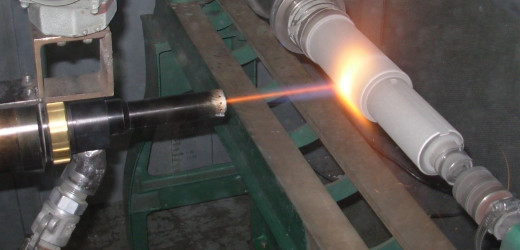
The set up requirements for particular areas of the HVAF and HVOF equipment are available by selecting the relevant tabs.
Compressed Air
Clean and dry air should be used for HVAF & HVOF operation.
Definition of “Clean”: Particulates of at least 10 micron size have to be removed from the supply air line. This is achieved by using the oil filter and particulate filter. For combustion air line, it is recommended to install the filters AFTER the receiver (air tank) to minimize air pressure drop in the receiver during the gun ignition (when high volume of air is used, resulting in fast pressure drop in the receiver).
Definition of “Dry”: it is rather a requirement for consistent moisture content in the air, than a requirement for a specific content of moisture (dew point). In fact, combustion is better initiated and sustained when moisture is present in the air due to high thermal conductivity of water. Herewith, heating of spray particles also depends on the gas heat conductivity – i.e., depends on the moisture content in the air. Thus, for consistent coating deposition and quality results, it is recommended that the moisture content in the air is consistent. The latter is usually achieved by installing a refrigerated air dryer in the line after the filters (unless the dryer is already integrated in the air compressor).
Single Designated Air Compressor Setup
- Designated rotary screw compressor: 400 CFM @ 125 PSI (approx. 100 HP) or larger is recommended to run all currently available guns. Minimal single air compressor requirements for each gun are listed in the Table 1. Maximum inlet air pressure into the console is 150 PSI.
- Dry and clean air (oil filter, particulate filter and refrigerating air dryer are recommended; all connections – 2” NPT).
- Recommended air pipe size: 2-inch pipe with 2”NPT connections minimal.
- Valve: shutoff valve must be installed.
- Connector after valve: Female 1-1/4” NPT (Kermetico supplies 5-feet 1-1/4” hose with Male 1-1/4” NPT nipple to connect to the control console).
Two Compressors Setup
- Designated air compressor for combustion line and separate air compressor for cooling line (only C-7 and C-6 guns).
Combustion line: designated rotary screw air compressor:
- C-7 Gun: 225 CFM @125 PSI (approx. 56 HP) or larger.
- C-6 Gun: 180 CFM @125 PSI (approx. 45 HP) or larger.
- Dry and clean air (oil filter, particulate filter and refrigerating air dryer are recommended; all connections – from 1” NPT to 1-1/4” NPT).
- Recommended air pipe size: 1-inch pipe with 1”NPT connections minimal.
- Valve: shutoff valve must be installed.
- Connector after valve: Female 1-1/4” NPT (Kermetico supplies 5-feet 1-1/4” hose with Male 1-1/4” NPT nipple to connect to the control console).
- Minimal compressor requirements are listed in the Table. Maximum inlet air pressure into the console is 150 PSI.
- The combustion air line in the console is oversized to 1-1/4” to allow running of AK7/AK6 HVAF guns, which have a single air supply for combustion and cooling.
Cooling line: Shop or designated compressor:
- C-7 Gun: 180 CFM @ 105 PSI (approx. 45 HP) or larger.
- C-6 Gun: 120 CFM @ 105 PSI (approx. 30 HP) or larger.
Clean air (oil filter, particulate filter for at least 25-micron particles removal are recommended; all connections – 1” NPT).
- Recommended Air Pipe Size: 1-inch pipe with 1” NPT connections minimal.
- Valve: Shutoff valve must be installed.
- Connector After Valve: Female 1” NPT (Kermetico supplies 5-feet 1”-hose with Male 1” NPT adapter to connect to the control console).
- Minimal compressor requirements are listed in the table below. Maximum inlet air pressure into the console is 150 PSI.
Minimal Requirements for Air Compressor for Different Spray Guns
| Gun | AK07 | C-7 | AK-06 | C-6 | AK5 | AK5-ID | AK4-ID |
| Nozzle | 5L | 5L | 5E | 5E | 100L | 60L | 2 |
| Chamber Pressure PSI | 64 | 73 | 75 | 73 | 78 | 79 | 78 |
| Air to Gun Setting PSI | 91 | 84 | 90 | 80 | 91 | 91 | 90 |
| Differential Pressure PSI | 27 | 11 | 15 | 7 | 13 | 12 | 12 |
| Air Flow SCFM | |||||||
| Total Work | 300 | 282 | 235 | 187 | 185 | 125 | 61 |
| Total Gun Startup | 360 | 382 | 300 | 270 | 240 | 185 | 85 |
| Combustion Air Work | 112 | 77 | |||||
| Combustion Air Startup | 212 | 160 | |||||
| Cooling Air | 170 | 110 | |||||
Compressor Minimal Requirements | |||||||
1. Single Compressor Setup | |||||||
Min. Pressure to Controller PSI | 108 | 100 | 108 | 100 | 105 | 105 | 110 |
Nominal Pressure PSI | 125 | 115 | 125 | 115 | 120 | 120 | 125 |
Min. Flow SCFM | 378 | 400 | 315 | 284 | 264 | 204 | 94 |
| Compressor HP | 95 | 100 | 79 | 71 | 66 | 51 | 24 |
| 2. Two Compressor Setup | C-7 | C-6 | |||||
| a) Combustion Air Compressor | |||||||
| Minimum PSI | 100 | 100 | |||||
| Nominal PSI | 115 | 115 | |||||
| Min. Flow SCFM | 223 | 168 | |||||
| Estimated HP Min. | 56 | 42 | |||||
| b) Cooling Air Compressor | |||||||
| Min. PSI | 105 | 105 | |||||
| Nominal PSI | 115 | 115 | |||||
| Min. Flow SCFM | 179 | 116 | |||||
| Estimated HP Min. | 45 | 29 | |||||
NOTE: When using carbon steel piping for air supply, it is highly recommended to set additional particulate air filter at the control console to capture fine rust forming in the piping.
Fuel
A supply of liquid propane (LPG, propylene, MAPP-gas) from cylinder or tank at pressure 100-120 PSI is required.
Typical Consumption of Fuel (Data for Propane)
| Gun | C-7/AK-07 | C-6/AK-06 | AK5/AK5-ID | AK4-ID |
| Gas Fuel Rate SLPM | 120- 150 | 90- 100 | 60- 70 | 20- 30 |
| Weight Consumption g/min | 236- 295 | 177- 196 | 118- 138 | 39- 59 |
NOTE: During the gun ignition the gas flow is 1.5 times higher than during the gun operation. For liquid withdrawal, the fuel cylinder must have so called liquid withdrawal valve, equipped with the dip-tube. Connection for liquid withdrawal valve (CGA 555 in the USA – “male” thread on the valve) is different than for gas withdrawal valve (CGA 510 in the USA – “female” thread on the valve).
Kermetico Supplies LPG Hose Assemblies, 15-feet each to connect:
- Cylinder to vaporizer (CGA 555 for liquid withdrawal to connect to cylinder, 1/4″NPT Female shutoff valve and 250 PSI hydro-static valve);
- Vaporizer to control console hose assembly
When using natural gas as a fuel, the inlet pressure of 110-140 PSI is required. Check needed consumption of the gas dependent on the gun type.
Fittings: 1/4″NPT x 3/8” JIC. Hose ID 3/8”.
Recommended Piping: Tube 3/8”OD x 0.305”ID
Pressure Buildup in the LPG Cylinder
Required minimum pressure of 100 PSI in the LPG cylinder is achieved when the cylinder temperature exceeds:
- 11°C – for propylene.
- 18°C – for propane.
- 31°C – for propane-35…40% butane LPG mixture.
- Over 44°C – for propane – 60% butane LPG mixture.
NOTE: The vaporizer does not increase the output gas pressure.
To reach/exceed needed 100 PSI pressure in the cylinder, 3 major methods can be used:
- Heating of the propane/LPG cylinder above mentioned critical temperature
- Using the liquid fuel pump
- Using the “nitrogen blanketing” approach
Heating of LPG cylinder
- Heating of LPG cylinder is easily achieved with electrically heated blankets, rated for hazardous area locations. Kermetico offers Power-Blanket (240 W, 110 VAC or 240 VAC) with heating temperature preset to 38°C (accuracy +/-5°C), rated for Class 1, Group D, Div.1 hazardous area locations (propane service, continuous hazard). Dimensions meet 100 LBS. (45 kg) cylinder size. The 2 blankets are recommended per such cylinder.
- Heating of LPG cylinders in hot-water bath is less convenient, but frequently used method for building the pressure in LPG cylinders. It has advantage over electrical heating when several cylinders are manifolded and heated simultaneously.
- Heating above 42°C is considered unsafe for LPG according to many local LPG Codes. Thus, heating should be not the choice for LPG with 50% or higher content of butane.
LPG Pump
By special order, Kermetico Inc. manufactures LPG pump station with differential pressure 80 PSI, maximum liquid flow 3 LPM (1.5 kg/min), powered with explosion-proof ¼ HP electrical motor (Class 1, Group C&D). The motor RPM setting is controlled by variable frequency drive.
Nitrogen Blanketing
The pressure in LPG cylinder is built up by adding compressed nitrogen into the gaseous phase of the cylinder. Beside liquid-withdrawal valve, the LPG cylinder (or tank) must have additional gas-withdrawal valve to connect to the source of regulated-pressure nitrogen.
Kermetico Inc. offers a nitrogen hose assembly for “Nitrogen Blanketing” setup. The assembly includes shutoff valve, check valve, flow-limiting valve and pop-off safety valve. The nitrogen hose is connected to the gas-withdrawal line of the LPG cylinder, while regulated pressure nitrogen is supplied to the hose from the nitrogen source (compressed nitrogen cylinder with regulator). Pre-set pressure on regulator creates the same pressure in the LPG cylinder through “nitrogen blanket”. The liquid fuel is supplied from the cylinder to vaporizer through the liquid-withdrawal valve at constant preset pressure.
Kermetico Inc. also offers Worthington 100-lbs. LPG cylinders, equipped with both liquid-withdrawal valve (dip-tube installed) and gas-withdrawal valve, as well as with filling up valve. The cylinders are rated to 290 PSI (test pressure 450 PSI).
Hydrogen
Use of hydrogen is optional.
- Kermetico supplies 15-feet hose, end 9/16”-18 Female Left-hand swivel. Customer should have a regulator with this connection. Required pressure of hydrogen after regulator is 120-135 PSI (8.4-9.5 bar). Consumption of hydrogen is up to 25 SLPM.
- The system has a built-in flame arrestor and a check-valve on hydrogen hose, as well as inlet and outlet pressure transducers, used for monitoring the line and safety shutdowns. It is recommended to install the flame arrestor on hydrogen regulator at the source, too.
- Fittings: 1/4″NPT x 9/16”-18 Left thread. Hose ID 1/4”.
- Recommended Piping: Tube 1/4”OD x 0.18”ID
Nitrogen
Kermetico supplies 15-feet hose, end 9/16”-18 Female Right-hand swivel. Customer should have a regulator with this connection. Required pressure of nitrogen after regulator is 140-160 PSI (9.8-11.2 bar). Consumption of nitrogen is up to 25 SLPM (usually 18-22 SLPM) during the gun operation and up to 60 SLPM – during the gun ignition.
NOTE: Hydrogen and nitrogen lines should have shutoff valves if cylinders are located distant from the equipment (i.e., pipe or hose lines are used additionally to Kermetico-supplied hoses).
- Fittings: 1/4″NPT x 9/16”-18 Right thread. Hose ID 1/4”.
- Recommended Piping: Tube 1/4”OD x 0.18”ID
Oxygen
Kermetico supplies 15-foot hose, end 9/16”-18 Female Right-hand swivel. Customers should have a regulator with this connection. Required pressure of oxygen after regulator is 130-140 PSI (9.1-9.8 bar). Typical consumption of oxygen is from 0 to 150 SLPM.
- Fittings: 1/4″NPT x 9/16”-18 Right thread. Hose ID 1/4”.
- Recommended Piping: Tube 1/4”OD x 0.18”ID
NOTE: Hydrogen, nitrogen and oxygen lines should have shutoff valves if cylinders are located distant from the equipment (i.e., pipe or hose lines are used additionally to Kermetico-supplied hoses).
Electrical Power
NOTE: All connectors should have “ground” wire.
- Vaporizer Torrexx TX-25: 220-240 V AC, Single-phase with ground, 25 Amps (the vaporizer power cord will not have a plug, length 15 feet). Wire AWG 10Or
Vaporizer Zimmer: 100-240 V AC, Single-phase with ground, max 5 kW. Wire AWG 12.
(It is recommended to install a switch similar to “motor starter” to turn the vaporizer On/Off) - Control console: either 110-115 V AC/ 5 Amps or 220-240 V AC/ 3 Amps, cord 12-feet.
- Powder feeder: either 110-120 VAC/3 Amps or 220-240 V AC/1.5 Amps, cord 5-feet.
For more information on our equipment setup, call us on 07 3823 1004, or email us using our contact form.