Page 6 of 7
Cylindrical Crusher Scrapper Blade

Industry: Brick and Tile Making
Principle of the Process: Mixing and forming of the clay.

Equipment Concerned:
The application with TufCote® Grade A-S (8mm or 6.35mm ⌀) flex-cord concerns mainly the mixing and forming phases:
- Mixer blades, cylinder scrapper blade, mixer screw, mixer knives,
- Thread flank of extrusion screw.


Service Conditions:
- Friction of the scrapper blade against the cylinder.
- Friction of the screw (diameter).
- For better efficiency during pulverising or mixing, the scrapper blade should remain in contact to the casing or cylinder.
- Ambient temperature ~20°C to 50°C.
- Abrasives particles mixed with water.
- Medium shocks resistance.
- Corrosion: Clay contains 7 to 30% water.
Problem:
- The scrapper blade should not scratch the cylinder or casing
- If scrapper blade do not remain in contact to the casing or to the cylinder: machinery efficiency during pulverising or mixing decreases and the quality of the mixed raw material change (bigger particles size, agglomerate…).
- Tools are subject to severe abrasion resulting from the minerals contained in the clay.
Coating Solution: Abrasion resistant coatings TufCote® Grade A-S Diam 6.35 or 8mm or TufCote® Grade M Diam 6.35 or 8mm: tungsten carbide with a metal matrix. 3 to 5 mm thickness are required.

Pug Mil Auger
Benefits of the TufCote® Grade A-S:
- Spherical tungsten carbide grains, do not damage the cylinder or the casing during friction.
- The shape of the scraper blade remain the same.
- Life time is 6 to 7 times more than lifetime with special steels.
- Significant reduction of the machinery power.
- No capital investment is required to apply the TufCote® brazing flexible cord (only a flame torch is required).
- Possible application on site or in job shop.
- TufCote® application procedure is easy to learn,
- TufCote® can be applied on construction steel (the hard steels, or special and expensive steels are not required)
- Possibility to rebuilt on a cladding previously welded.
- The coaxial metal wire inside the cord and avoids "butt" effect.
TufCote® GRADE A-S Product Specification
- Self fluxing alloy matrix: 37 to 40% in weight
- Tungsten carbides: 60 to 63% in weight
- Particle size: Grade A-S within 0.1 to 0.8mm
- Packaging: TufCote® is supplied as a continuous flexible cord, length depending on diameter and included in a protective plastic box. Available diameter 6.35mm or 8mm.
TufCote® Application Procedure:
Preparation of the Piece
- Surface must be cleaned and free of surface contamination.
- All edges must be cut by grinding.
Preheating of the Area
- With oxy-acetylene torch, preheat the piece area to 450°C (840°F).
Prime Cote (if required)
PRIME COTE under layer might be applied about 300μm thick.
- To avoid oxidation of surface.
- To increase TufCote® bonding.
- To prevent chromium migration to the surface (black bulk).
Hard-facing Operation
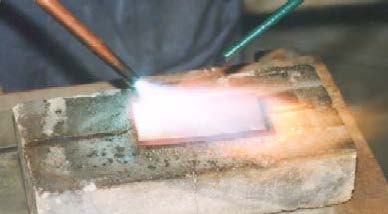
- The torch flame must form an angle of about 45° with the piece surface to be hard-faced, and TufCote® at a 45° angle to the same surface.
- The flame must swing from side to side of the weld cladding.
- TufCote® is then fed through the holder 4-6” at a time.
- The tip of the cord should not be lowered or lifted during fusion.
- Speed of cladding is ~2Kg/h.